
Sgt John Douglas Dadswell (1678501) Air Gunner served in RAF 625 Squadron. He was killed March 3rd 1944 in Lancaster III ND637 having completed an operation to Stuttgart, Germany. He was 19. His aircraft collided with Lancaster ED606 of 463 Squadron, whilst in a circuit to land. His grave is in Harton Cemetery, South Shields, Section 5 Grave 10099.
His Crew:
Pilot P/O John Percy Bulger RCAF J/85931
Flight Engineer Sgt Alfred William Aiston RAF 1532964
Navigator W/O Gordon Ivey RCAF R/150959
Bomb Aimer F/O Robert Roy Jones RCAF J/25514
Wireless Op Sgt Dennis Hewitt RAF 1490563
Rear Gunner Sgt Richard Janes Fettis RAF 1126142
John was the Mid Upper Gunner in the centre of the Lancaster.
The crew were posted to 625 Squadron January 25th 1944, just days before they were killed.
John’s parents were Harry (1878) and Elizabeth Ann(1880) (nee Lake) Dadswell of South Shields. He was born in 1924 in South Shields.
He came from a large family consisting of Ernest ‘Billy’ William, Harry, Ralph, Thomas, George, Alf, Horatio, Frank, David and Peggy.
Privates Alfred and Horatio were stationed in the UK.
Frank served in the Merchant Navy.
David worked in the mine.
Peggy served with the Naffi.
George and Ernest took part in the invasion of France and met by accident on the landing beach, where they were allowed to spend a few hours off duty together.
Thomas fought in France, before being sent to India and Burma. When the majority of the men had been taken off at Dunkirk, he was left behind and spent several days in hiding, until he was able to get on board a British vessel further up the coast.
His brother Frank helped to evacuate many of the soldiers.
Alf was a Sapper in the Royal Engineers in India. He was wounded 2/6/1940.
Ernest William in the Royal Scots was killed in Holland in October 1944.
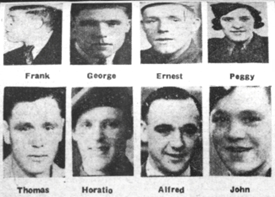
The Shields Gazette 21/3/1944
The parents of Sgt Air Gunner John Douglas Dadswell, Mr & Mrs Dadswell of 245 South Frederick Street, South Shields, have received official news that their son has died as a result of operations. Sgt Dadswell was 19 and had just been recommended for promotion to Flight Sergeant. Educated at South Shields Central School, and employed by South Shields Building Society before the war. When war broke out, he joined the South Shields ATC and became a sergeant before joining the RAF. He was the youngest of 10, 6 of whom are in the forces, 4 Army, 1 Merchant Navy.
Official Investigation RAF
Time of accident 03h05 near Waddington.
Lancaster III ND637 was detailed for operations the 15/16th March 1944 – target Stuttgart. The aircraft took off from thus aerodrome, but on the return journey it collided with another aircraft and burst into flames and crashed at 03h05, the location being 5308 degrees N 0027 degrees W. All the occupants were dead when extricated from the aircraft. Multiple injuries and instantaneous death. No technical failure involved.
Extract from the Court of Inquiry into the accident involving Lancaster ED606
Conclusions:
Lancaster ED606 of 463 Squadron while circling Wellington airfield preparatory to landing after an operational sortie, was in collision with Lancaster ND637 of 625 Squadron. ND637 was returning from an operational sortie. The collision occurred at 1,800ft and both aircraft were totally destroyed and all killed.
Presumed failure of the pilots and crews of both aircraft to maintain an adequate lookout.
Recommendations:
Routes. The command route for the return from operations for the night 15/16th March was Selsey Bill – Reading – Base. This meant the aircraft of No. 1 Group, were in many cases bound to fly over the No. 5 Group airfields. It is therefore recommended that Groups should be given routes so as to avoid infringing other Groups areas whenever possible.
Private Ernest William ‘Bill’ Dadswell 8th Bn Royal Scots 4399211 killed 31st October 1944
8th Battalion Royal Scots took part in Operation Pheasant from October 20th 1944 with the object of liberating Tillbury. Then on the 28th the battalion was ordered to urgently prepare to leave the Peel area, as a German counter attack was in progress from the 27th, at Ospel, Meijel, Neerkant and Lissel.
8th Battalion left Tillbury at 0215 on 29th October in the direction of Deurne and arrived at 07:30. At 14:00 the Battalion was ordered to leave for the village of Rinkveld, to take up positions at 17:00.
Contact was made with the Germans, via patrols in the Dennendijke forest. 8th Battalion A and B Companies came under light artillery fire.
On the 31st they were ordered to recapture the forest from the Germans. At 14:45 the attack began with the support of 1 squadron of 4th Battalion Grenadier Guards. 8th Battalion came under heavy artillery fire. They lost 4 officers and 48 other ranks killed and wounded. 8 of the other ranks were initially buried in Lissel – including Bill Dadswell. He was reburied 26/8/1946 in Nederweert War Cemetery Grave 11G 5.
Sources:
FindmyPast
Canadian National Archives
Australian National Archives
theroyalscots.co.uk
Written and Researched by Dorothy Dickson Ramser November 2025